
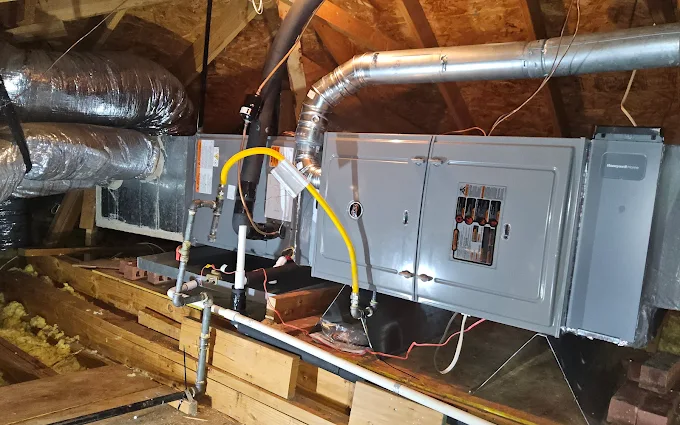
Duct Installation Design for Balanced Room Airflow
Last summer, a homeowner in The Woodlands called Conley Cooling and Heating because their living room felt fine—but three bedrooms down the hall stayed noticeably warmer. The thermostat was set the same for every room, the AC ran plenty, and yet the temperature swings didn’t make sense.
That’s a common comfort problem we see when ductwork design and installation don’t match the home’s layout and airflow needs. In Southeast Texas, where humidity and outdoor temperatures stay high for long stretches, even small duct issues can show up fast: rooms won’t cool evenly, the system may run longer than it should, and humidity can linger even when the house “feels” cool.
Quick Answer
Balanced room airflow starts with duct design that matches the load (how much cooling/heating each room needs) and the path air must travel. A proper duct installation considers:
- Supply and return placement
- Duct sizing and layout (especially long runs and tight corners)
- Airflow balance at registers and returns
- Static pressure limits so the system can actually move air
- Proper sealing and insulation to prevent conditioned air loss
If any of those are off, you can end up with cold drafts in one area, warm pockets in another, and higher energy bills across the board.
What Homeowners Often Overlook
Many homeowners assume ductwork is mostly “plumbing”—set it and forget it. In reality, duct design is an airflow system. The AC has to move air through a network of ducts, fittings, and grilles, and it’s sensitive to resistance (static pressure). When duct installation doesn’t account for that resistance, the blower can’t deliver the airflow the equipment is designed to provide.
A firsthand technician observation
On site, one of the quickest clues we look for is the “relationship” between supply vents and return paths. If a bedroom is getting supply air but there isn’t a good return route (or the return is too restrictive), that room can struggle to reach temperature. The same issue can happen when duct runs are added after the fact—like when a room gets enclosed or a ceiling is lowered—without redesigning the airflow balance.
What We Commonly See in Southeast Texas HVAC Systems
Southeast Texas homes face two realities that make duct installation especially critical:
1. Long cooling seasons mean any inefficiency gets repeated daily.
2. High humidity means comfort isn’t just temperature—it’s moisture removal and air mixing.
When air distribution is uneven, the AC’s dehumidification performance often suffers. Some rooms may get enough airflow to feel cool, while others receive less air and hold onto moisture longer. You’ll still hear the system running, but the indoor environment doesn’t stabilize the way it should.
Realistic example (anonymized service case)
We recently worked with a customer whose new central system was installed, but their upstairs rooms stayed warm. The ducts were “installed to fit,” not installed based on measured airflow targets. The upstairs supply runs were longer and had more turns than planned, and the return path relied on a weak transfer grille. Once we redesigned the register layout and corrected duct sizing and balancing strategy, the temperature differences narrowed significantly without increasing equipment runtime.
Common Mistakes Homeowners Make
1) Treating ductwork sizing as a “standard fit”
A duct that’s slightly undersized or poorly routed can increase resistance. The blower may move less air than expected, which leads to warm rooms and higher duct losses.
2) Ignoring returns and pressure balance
Supply air without a proper return path can cause pressure imbalances. Rooms can feel stuffy, struggle to cool, and sometimes even pull air from unwanted places (like unconditioned spaces).
3) Skipping sealing and insulation details
Leaky ducts don’t just waste energy—they change system performance. In attics or crawlspaces, leaks can also pull in unconditioned air and humidity, undermining comfort.
4) Assuming a thermostat upgrade fixes airflow problems
Thermostats control temperature at a sensor. They can’t correct duct restrictions or poor room balancing. If airflow is wrong, a “smarter” thermostat just makes the system work harder to chase an inaccurate comfort outcome.
5) Designing for “average” loads instead of room-by-room needs
Homes rarely have uniform cooling/heating demands. Large windows, sun exposure, ceiling heights, and room usage patterns all matter. Duct design should reflect those differences.
Repair, Installation, or Efficiency: What Actually Improves Indoor Comfort
Balanced airflow isn’t one single fix—it’s a design-and-commissioning process. Here’s what a professional duct installation design should include.
Duct installation design checklist (what good looks like)
- Room-by-room airflow targets based on cooling/heating load and room layout
- Supply duct sizing to support required airflow without excessive static pressure
- Return duct planning to ensure each comfort zone can evacuate air properly
- Register placement that supports air mixing without causing drafts
- Duct sealing using appropriate materials and methods (especially joints and transitions)
- Insulation for ducts in unconditioned spaces to reduce heat gain/loss
- Airflow verification and balancing after installation (not just “it feels okay”)
- System commissioning so the blower and equipment operate within intended parameters
A note on measurement: balancing isn’t guesswork
In the field, we often use airflow measurements to confirm supply volumes and return adequacy. The goal is to achieve consistent comfort without overworking the system. If you only adjust dampers by feel, you can accidentally create problems elsewhere—like making one room cooler while starving another.
Where duct repair fits
If your issue is uneven comfort in an existing system, duct repair may be the most direct route—especially when you suspect leaks, crushed sections, or disconnected runs. You can explore duct repair services if you’re dealing with suspected duct leaks or poor air distribution.
HVAC Maintenance Checklist (for better airflow year-round)
Even the best duct design can drift over time if the system isn’t maintained. Use this practical checklist:
- Change or service air filters based on your household needs (pets, allergies, dust)
- Check supply and return registers for blockages (furniture, rugs, insulation debris)
- Inspect visible duct connections for gaps or disconnected sections after renovations
- Schedule HVAC tune-ups to confirm blower performance and airflow capacity
- Verify thermostat placement (avoid heat sources, direct sun, or blocked airflow)
- Monitor humidity—in Southeast Texas, comfort often fails when moisture isn’t controlled
If you’re planning maintenance alongside comfort improvements, consider pairing ductwork work with air conditioning tune-ups to confirm the system is delivering the airflow it was designed for.
The Woodlands / Southeast Texas Relevance
In The Woodlands and surrounding Southeast Texas communities, homes often have attics that bake in summer heat, and many properties include additions, vaulted ceilings, or room conversions. That means ductwork is frequently modified after the original build—sometimes without redesigning airflow paths.
When duct installation doesn’t account for those changes, you’ll typically see:
- warm rooms at the far end of supply runs
- longer cooling cycles due to higher resistance
- humidity that lingers in “underfed” rooms
- higher utility bills because the system keeps running but comfort doesn’t improve
Balanced airflow matters even more here because moisture control depends on correct air movement across the system and within each room zone.
What Businesses Should Know About Airflow Balancing
Commercial spaces—offices, salons, small medical practices, and warehouses with rooftop units—also suffer from uneven airflow when duct design and balancing aren’t handled carefully. In many cases, comfort complaints show up before equipment failure: employees feel hot near vents, customers complain about stuffiness, and productivity drops.
A strong approach includes:
- zoning design that matches occupancy and usage patterns
- verified airflow at diffusers and returns
- duct sealing and insulation where systems penetrate unconditioned areas
- coordination between thermostat/control strategies and actual airflow
If your business is dealing with system issues, you can also review commercial ac services to align comfort and performance goals.
Quick Comparison: Duct Design vs. “Just Tune the Thermostat”
| Approach | What it fixes | What it won’t fix |
|---|---|---|
| Balanced duct installation design | Air distribution, room-to-room comfort, return adequacy, system efficiency | Programming issues that don’t match airflow realities |
| Thermostat changes or settings | Temperature control at sensor, scheduling, comfort “feel” in some cases | Poor duct sizing, leaks, restrictive runs, weak returns |
| Quick adjustments without measurement | Small localized issues | System-level airflow imbalance caused by design/installation errors |
For homeowners, the takeaway is simple: if your problem is uneven comfort, ductwork design and balancing come first. A thermostat can help you manage comfort—but it can’t replace airflow.
Signs Your HVAC System Needs Attention
- One or two rooms never reach the set temperature
- The system runs longer than usual with limited comfort improvement
- You feel cold air drafts in some areas but warm pockets elsewhere
- Humidity stays high even when the AC runs frequently
- After renovations, comfort issues started or worsened
If any of these match your situation, it’s worth inspecting ductwork and the airflow pathway before assuming the equipment is failing.
HVAC Maintenance Checklist: Best Next Step for Comfort
Before the hottest weeks hit, schedule a comfort-focused evaluation that includes:
- airflow verification,
- duct sealing/inspection where accessible,
- and balancing recommendations based on actual measurements.
If you’re also considering air cleaning to support healthier indoor air, you may want to coordinate airflow improvements with filtration upgrades like air filtration system installation. Cleaner air is great—but it should be matched to system airflow so the filtration doesn’t inadvertently restrict performance.
Best Option for Southeast Texas Homes
If your goal is balanced rooms and consistent comfort, the best approach is usually:
1) correct duct design and ductwork installation details,
2) verify airflow and balance,
3) then optimize filtration and humidity control strategies.
That sequence prevents “band-aid” fixes. You get better temperature stability and better moisture removal without forcing your system to run harder than it should.
Optional FAQ
Why does my AC run constantly but some rooms stay warm?
Constant runtime with persistent warm rooms usually points to airflow imbalance. Common causes include restricted duct runs, leaky ducts, undersized supply lines, or inadequate returns that prevent air from circulating properly. In Southeast Texas, humidity can also mask comfort improvements—so the system may cycle longer to manage moisture while still failing to deliver proper air volumes to every room.
Can duct sealing alone fix uneven temperatures?
It can, especially if you have measurable leaks or ducts are pulling in unconditioned air. However, sealing is most effective when paired with airflow verification and balancing. If the duct sizing or register layout is off, sealing alone won’t fully correct distribution.
Should I upgrade my thermostat if rooms are uneven?
A thermostat upgrade can improve control and scheduling, but it won’t fix duct restrictions or missing return pathways. In many cases, we recommend addressing ductwork design and balancing first, then fine-tuning comfort control with the right thermostat setup. If you want thermostat-related support, you can explore thermostat installation services once airflow is corrected.
How do I know if my ductwork needs repair vs. replacement?
If ducts have localized damage, disconnected sections, or leaks in accessible areas, duct repair may be enough. Replacement is more likely when duct layouts are fundamentally mismatched to the home’s current configuration (additions, remodels, or changed ceiling heights) or when the system’s airflow capacity can’t be achieved due to design limitations.
Ready to Improve Your Indoor Comfort and Energy Efficiency?
If you’re dealing with uneven room temperatures, persistent humidity, or rising utility bills, balanced duct installation design is often the missing piece. The team at Conley Cooling and Heating can inspect your airflow pathway, recommend ductwork improvements, and help you get the comfort your system was built to deliver.
About Conley Cooling and Heating
Conley Cooling and Heating provides AC repair, air conditioning installation, heating services, indoor air quality solutions, ductwork services, ductless mini splits, heat pump systems, thermostat upgrades, and commercial HVAC support throughout The Woodlands, TX and surrounding Southeast Texas communities. The company focuses on reliable comfort solutions, energy-efficient system performance, indoor air quality improvement, and helping homeowners and businesses maintain dependable heating and cooling year-round.